
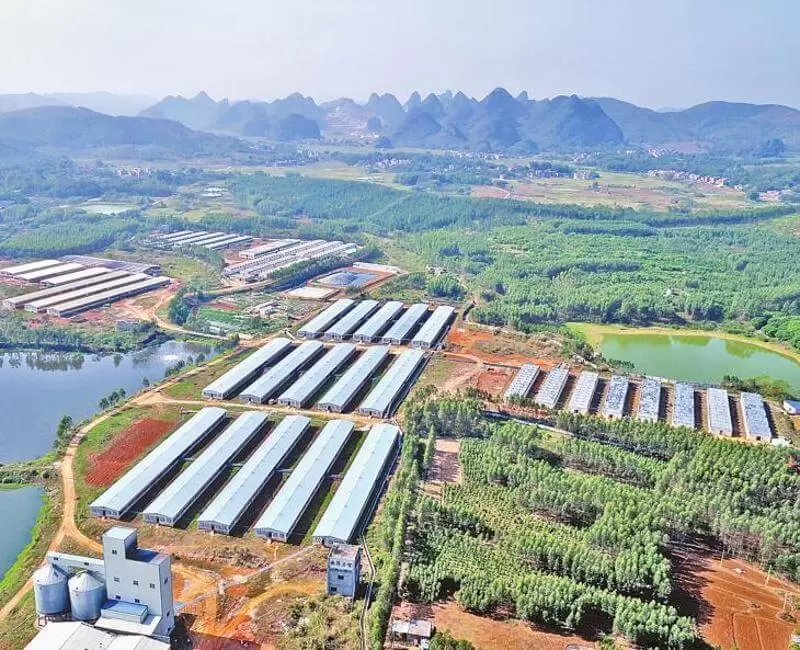
Site Layout Planning for Pig Farms
After selecting the site, plan the farm layout according to near- and long-term goals, following principles that favor production, biosecurity, land efficiency, and convenient management and transport. Consider local climate, prevailing wind, topography, building sizes and facility needs when planning roads, drainage, landscaping, and the location and orientation of functional areas and buildings. Typically the site is divided into four functional zones: living (residential) zone, production-management zone, production zone, and isolation (biosecurity) zone. For biosecurity and safety, arrange these zones in sequence relative to the prevailing wind and terrain.
Living Zone
The living zone includes offices, reception, finance, canteen, staff dormitories, and other facilities for managers and families and should be isolated from production areas. Place it upwind of the production zone or along a side parallel to the wind. Surround the farm with a perimeter wall or a disinfection/defense ditch to prevent animal intrusion and unauthorized access.
Production-Management Zone
This zone contains auxiliary buildings essential for production management, such as feed processing workshop, feed storage, repair shop, substation, boiler room, and pump house. Because it is closely related to daily husbandry operations, it should be located near the production zone.
Production Zone
The production zone is the core of the farm and includes all barns and production facilities, typically accounting for 70%–80% of total building area. No external vehicles are allowed into this zone and vehicles from this zone should not leave the production area without proper control. Provide a loading/unloading platform at the perimeter and prohibit external vehicles from entering. Install a dedicated disinfection room or disinfection pool at the production-zone entrance for strict disinfection of personnel and vehicles.
Barn layout: Arrange barns according to biological and production needs of each pig class. The breeding herd zone should be in a low-traffic, upwind location. Boars should be placed upwind within the breeding area and at least 20 m from sow houses to prevent boar odor distress and to use boar odor to stimulate sow estrus. Commercial pig areas require separation: gestation and farrowing (reproductive) barns should be well-sited—farrowing units should be close to both gestation and nursery barns to ease transfers. Finisher barns are best located downwind and near the loading platform.
Feed processing workshop: Place centrally to minimize feed transport distance for feeding and to facilitate material delivery. Feed bins and silage pits should be adjacent to the feed mill.
Artificial insemination room: Locate alongside the boar house. If it handles outside-sow breeding, provide double (interior/exterior) doors.
Isolation Zone
The isolation zone contains quarantine barns for newly purchased breeding stock, sick-animal isolation, veterinary clinic, carcass autopsy/disposal facilities, manure accumulation and storage. This critical biosecurity area should be downwind or off-wind and on lower ground to avoid affecting production herds. Install isolation walls at least 3 m high; entry/exit should have disinfection pits filled with 2% sodium hydroxide solution to prevent disease spread and environmental contamination.
Roads
Design internal and inter-zone roads to meet operational, management, and biosecurity needs. Gateways must be provided between the living zone and the outside and between the living and production zones. The gate between living and production areas should be kept closed—use it only for firefighting or special access; routine personnel access must go through a disinfection shower/garment-change room. Roads are essential for hygiene, biosecurity, and operational efficiency. Separate clean roads and dirty roads with no intersections and separate access points: clean roads are for personnel and feed/product transport; dirty roads are for manure, sick pigs, and waste equipment. Road surfaces should be firm, well drained, not overly smooth, and have a cross slope around 10% for drainage. For larger farms, main roads should be 5.5–6.5 m wide and secondary roads 2–3.5 m wide.
Water Tower
A water tower ensures reliable clean-water supply. Site it according to water-source conditions and place it at the highest point of the farm.
Recent Comments