
Building Types and Interior Layouts for Different Pig Houses
Boar House
Boar houses can be standalone or arranged opposite breeding sow pens. Design must protect hooves and meet the scrotal temperature needs to ensure mating ability and semen quality. Typical layout: single-row pens with an exercise yard. Exercise yards prevent obesity, improve health, semen quality and service life. In cold regions, place the outdoor yard opposite the indoor boar pen. Flooring should be non-slip but not overly rough, with a 3% slope. Pen height ≥1.2 m to prevent climbing; pen area typically 6–7 m² or larger. Breeding boars are housed individually. High temperatures impair semen vitality and increase dead sperm; install cooling systems (fogging, evaporative pads, ventilation, air conditioning). Pen fences usually use rails to maximize airflow.
Gestation Sow House
Gestation houses may be single-row (with exercise yard), double-row, or multi-row. Sows can be group-housed or individually housed. Group housing (4–5 sows per pen) saves space and can stimulate estrus but makes heat detection harder and increases risk of competition, fighting, stillbirths and abortions. Individual housing facilitates heat detection, breeding, pregnancy maintenance and controlled feeding, but reduces exercise, can lower conception rate, increase hoof disease, and shorten productive life. A compromise is group pens with feeding stalls: sows enter feeding stalls to eat and otherwise move freely in the pen. This provides exercise, reduces hoof problems and dystocia, and increases longevity, though group housing raises fighting risk.
Farrowing and Lactation House
Farrowing/lactation houses are the highest-investment, best-equipped, and best-insulated units. Commonly three-aisle, double-row layout. Design must satisfy both sows and piglets: sow comfort temperature ~16–18°C; newborn piglets need ~28–32°C. Piglets huddle against the sow for warmth, risking crushing. Layout includes a sow confinement area and piglet activity area: middle sow crate width ~0.6–0.65 m; piglet areas on both sides with creep feeders and heated creep boxes (heated floors, infrared lamps). Creep boxes are used early and removed as piglets grow. In intensive systems, early weaning is common. Sows enter farrowing house about one week pre-farrowing; lactation typically 28–35 days; with cleaning/disinfection turnaround, each farrowing stall is occupied ~5–6 weeks.
Nursery (Weaner) House
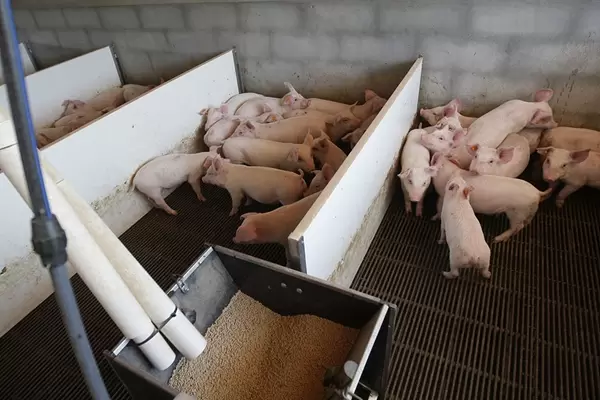
Weaned piglets are moved to the nursery, which must provide a warm, clean environment because piglets have poor thermoregulation and immunity. Nurseries and farrowing houses generally require heating in winter. Common practice is group housing on raised woven-mesh flooring (wire or plastic) elevated 0.3–0.5 m to avoid cold concrete. Typical nursery stall area 3.2–3.4 m² (length 2.0 m, width 1.6–1.7 m, height 0.65 m), equipped with feeders and drinkers; a wooden board by the feeder serves as a lying area. Each pen may hold 10–12 weaners (35–70 days old). Keeping littermates together (one litter per pen) reduces fighting from re-establishing social order.
Grower–Finisher House
Grower–finisher pigs have more mature physiology and stronger resistance, so various pen forms are acceptable. Heating is usually unnecessary in winter, but summer cooling and ventilation are important. Prefer keeping original litter groups; alternatively combine two litters per pen (~20 pigs). Typical pen dimensions: length 5.0 m, width 2.4–3.2 m, height 0.9–1.0 m; usable area 12–17 m², ~0.6–0.8 m² per pig. Floors often have one-third slatted area with manure channels beneath. Pens include automatic feeders and drinkers for ad libitum feeding and drinking.
Recent Comments