
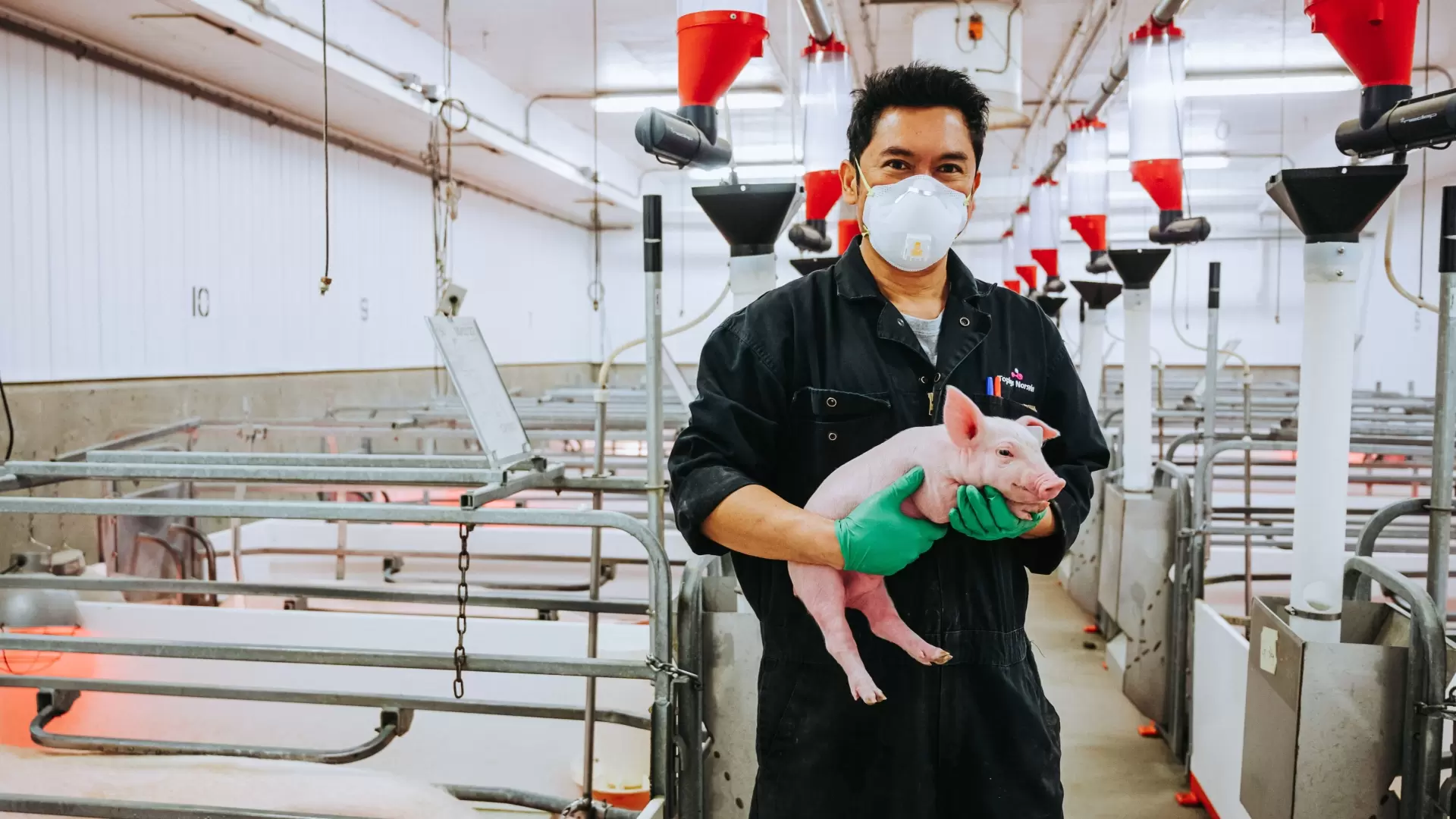
Will the Future Belong to Corporate Complexes or Family Farms?
Which model will dominate pig farming in China: family farms or corporate complexes? This is not only a domestic debate but mirrors a global choice faced during modernization: a dynamic balance between efficiency and risk. Two leading hog-producing countries followed opposite paths, representing the extremes of this debate.
The U.S. path — vertically integrated corporate complexes
In one path, the industry underwent radical consolidation into vertically integrated corporate complexes that control breeding, feed, production standards, slaughtering and processing. A few giant firms account for a very large share of national slaughter capacity. These companies capture extreme scale economies and market power while often relying on a mix of company-owned farms and a network of contract farms that operate pig stalls and barns under strict corporate control.
Advantages
Extreme cost efficiency: vertical integration eliminates transaction costs across the chain, enabling standardized large-scale production and relatively low unit production costs.
Scale-driven R&D: only very large operations can sustain continuous investment in genetics, precision nutrition, digital management and disease research.
Natural market hedging: owning both production and processing assets provides partial hedging between high live pig prices (benefiting producers) and low prices (benefiting processors).
Export competitiveness: end-to-end control of quality, safety and cold-chain logistics is essential to access high-standard export markets.
Mixed asset model: relying on contracted family farms for part of supply creates a “light-asset + heavy-control” hybrid that captures some flexibility.
Limitations
Systemic fragility: dense flows of breeding stock, piglets, feed and personnel become fast lanes for disease spread; high efficiency increases systemic vulnerability.
Heavy fixed costs: full-chain asset intensity magnifies losses in price downturns as depreciation, interest and labor remain high.
Rising compliance costs: large integrators face escalating environmental, welfare and antitrust scrutiny that are costly and hard to pass to consumers.
Contract farmer imbalance: contract growers often lack bargaining power over prices, feed and technical standards, creating long-term social and legal tensions.
Innovation misalignment: deep internal binding between chain segments can slow response to disruptive alternatives (e.g., novel proteins), making transformation costly.
Conclusion on this path
Vertical integration is an “extreme-efficiency” outcome under specific historical conditions. It can deliver low costs and scale advantages but carries systemic, social and financial risks. For China, corporate vertical integration can be a tool but should not be treated as an end: resilience, legitimacy and fair benefit distribution matter for long-term health.
The Danish path — specialized family farms plus cooperatives
In the other path, the industry is dominated by owner-operated family farms of modest size, each running pig stalls and barns, combined with powerful farmer-owned cooperatives that centralize breeding, technical R&D and marketing. Farmers supply pigs while also being cooperative members and shareholders; professional managers run commercial operations on behalf of the cooperative.
Advantages
Balance of efficiency and flexibility: farmers focus on production and refinement, cooperatives provide market scale, avoiding the “too big to manage” downside of giant integrators.
Aligned incentives: as both suppliers and owners, farmers receive returns through both sales and cooperative dividends, reducing principal–agent conflict.
Distributed resilience: thousands of independent farms disperse production risk; a centralized processing cooperative retains market bargaining power.
Sustained innovation: member-driven governance channels farm needs into breeding and technical services, with genetic gains shared across members.
Strong advisory ecosystem: well-developed veterinary, extension, finance and service networks support farm performance.
Limitations
Land dependence: strict environmental rules linking manure application to owned cropland require sufficient land per farm, limiting scalability where land access or transfer is constrained.
Export dependence: heavy reliance on export markets makes the sector vulnerable to trade barriers and global shocks.
Governance strain at scale: one-member-one-vote works well for smaller memberships, but large cooperatives face governance drift toward professional managers and reduced member influence.
Cost pressure: high domestic labor, land and compliance costs can erode competitiveness versus lower-cost regions, prompting relocation of some processing capacity.
Reliance on service systems: the model depends on mature external support systems that take decades to build.
Conclusion on this path
The family-farm-plus-cooperative model is an elegant institutional design that combines farm-level incentives with market-scale coordination. Its prerequisites—land arrangements, export orientation, cooperative culture and mature service systems—are demanding. The lesson for China is not to copy this model wholesale, but to design institutions that truly make family farm owners members of the value community rather than mere contractors.
Overall conclusion for China
The global experience shows this is not a strict either/or choice. Corporate vertical integration delivers peak efficiency but less resilience and social alignment; family farms embedded in cooperatives deliver incentive alignment and resilience but require supportive institutions and may face cost and export vulnerabilities. For China, the optimal path is a context-specific blend: use vertical integration where it improves efficiency and market access, while building cooperative-like structures, better contract terms, social legitimacy and service systems that strengthen family farms and pig stall operators. Governance, risk diversification and fair benefit sharing should be explicit objectives alongside productivity gains.
Recent Comments