
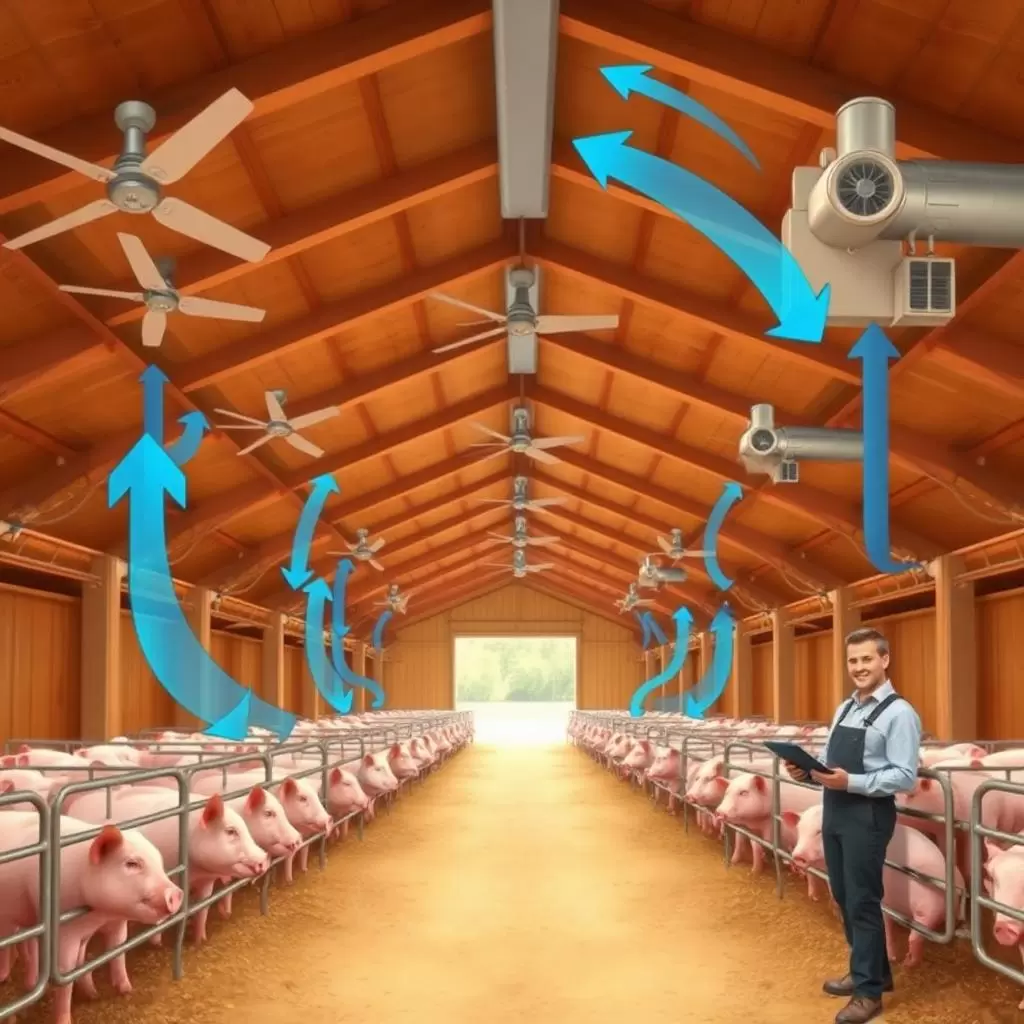
Ventilation Modes — Advantages and Disadvantages
- Natural ventilation
- Advantages: low capital and operating cost; simple system; no fans/energy required.
- Disadvantages: highly weather-dependent (wind speed/direction); poor control of airflow and indoor environment; harder disease/biosecurity control; vulnerable to dust, rain and seasonal extremes; reduced effectiveness when combined with powered fans if poorly designed.
- Negative-pressure (exhaust fan) system
- Advantages: most widely used; simpler ducting; ventilation rate controlled by fan capacity; good cooling when intake inlets are well designed; relatively lower installation cost than complex systems.
- Disadvantages: requires high building airtightness (doors/windows/other openings must be sealed); inlet design and placement critical for uniform airflow; incorrect inlet sizing or long houses cause uneven ventilation and temperature gradients; performance falls if building leaks; can be noisy near fans.
- Positive-pressure (supply-driven) system
- Advantages: quieter inside house; good control of where fresh air enters; easier to control incoming air distribution via ducts and diffusers; can reduce ingress of dust/pathogens when filtered; flexible by closing individual supply inlets.
- Disadvantages: requires careful duct and outlet sizing (to keep outlet airspeed ~4–5 m/s); outlets (doors/windows) must tolerate discharge (freeze protection in winter); higher design and installation complexity and cost; must ensure even distribution to avoid drafts or dead zones.
- Balanced/equal-pressure (combined supply + exhaust) system
- Advantages: combines strengths of positive and negative systems; maintains near-constant internal pressure even with building leaks; more stable airflow distribution; useful for large, filtered or biosecure houses.
- Disadvantages: highest capital and control complexity; needs coordinated control of supply and exhaust fans and carefully sized ducts/outlets; higher operating cost and maintenance.
Practical recommendations
- Small/low-cost farms: natural ventilation can work if climate mild and management adapts, but biosecurity and winter control are limited.
- Most modern intensive farms: negative-pressure systems are common for cost-effectiveness, but require tight building sealing and well-designed inlets.
- Air-filtered or biosecure areas (quarantine, SPF): positive or balanced systems are preferred to control incoming air quality and maintain pressure regimes.
- For long houses or unequal spans: avoid single-end inlet designs without careful CFD/inlet layout — otherwise internal temperature and airflow will be uneven.
- In all systems: aim for inlet airspeed at distribution points ≈4–5 m/s for proper penetration; test airflow distribution (smoke tests); apply winter minimum-ventilation strategies and freeze protection for outlets; integrate automatic controls tied to temperature, humidity, and CO2/NH3 sensors for best performance.
Recent Comments