
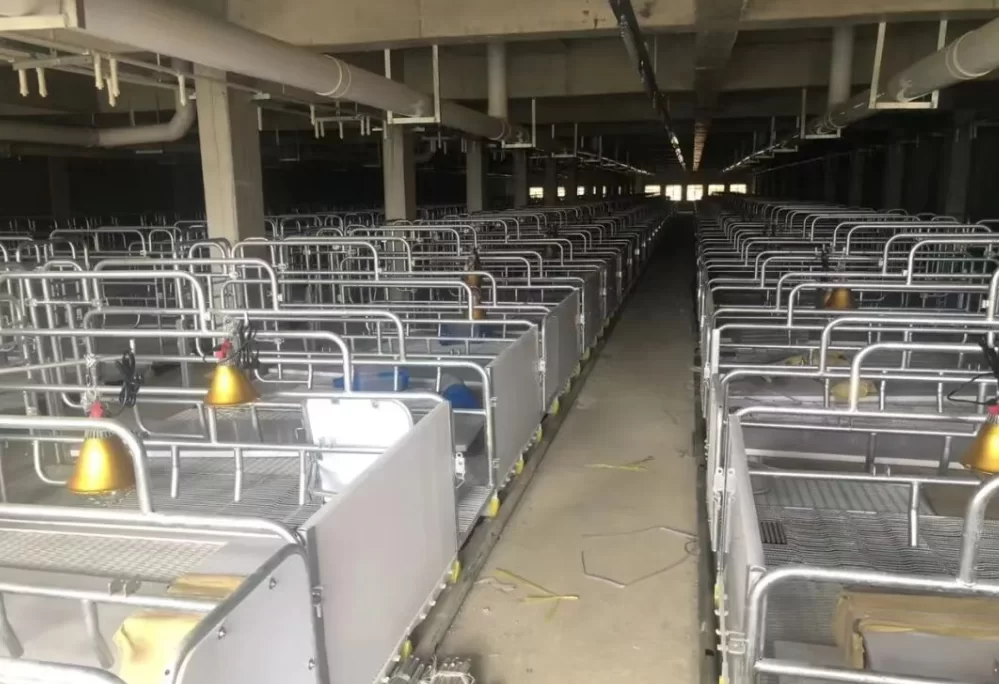
Common Pig-Stall Facilities
A pig stall is the basic unit of a pig house. Stall shape and dimensions must meet the needs of different pig categories and ages and allow easy worker operation. Stalls are classified by material into solid stalls, slatted-bar stalls, composite stalls, and prefabricated stalls.
Solid stalls: masonry (120 mm thick, 1.0–1.2 m high) finished with cement plaster, or assembled from precast concrete components.
Slatted-bar stalls: welded metal sections forming bars; bar spacing limits: adult pigs ≤10 cm, suckling piglets ≤3.5 cm, nursery pigs ≤5.5 cm, growers ≤8.0 cm, finishers ≤9 cm.
Composite stalls: combination of types (e.g., solid partition between adjacent stalls, slatted front along the feeding alley).
Stalls are also categorized by animal use: boar stalls, mating stalls, sow stalls, farrowing stalls, nursery stalls, grower stalls, finisher stalls, etc. Stall footprint depends on pig numbers and required area per head.
Boar and mating stalls Design for one boar per stall, typically 6–7 m² or larger. Dimensions depend on in-house framing; height usually 1.2–1.4 m. Structures can be metal or concrete; doors are metal. Note: if boars can easily climb the stall, self-stimulation and genital injury or poor semen quality may result. Too-narrow stalls cause testicular abrasion and reduced fertility. Mating stalls can be dedicated or combined with boar or sow stalls. Common configurations:
Adjacent sow stalls to one boar stall (3–4 sows per boar), where the boar stall doubles as the mating stall.
Opposite sow and boar stalls across an alley; visual contact via iron rails helps induce estrus though direct contact is absent.
Separate boar and sow stalls plus a dedicated mating stall where both animals are moved in for service.
The first two layouts are most used in larger, intensive farms since they avoid a dedicated mating stall and simplify operations.
Sow stalls
Modern sow housing methods: group large-pen group-housing, small individual restricted stalls, or mixed systems combining both. Individual stalls use less area, ease heat detection and timed breeding, prevent competition and fighting, and reduce abortions, but cost more and limit exercise, which shortens sow productive life and increases hoof problems. Stall dimensions depend on house framing; stall height usually 0.9–1.0 m. Typical individual stall: length 2.0 m, width 0.65 m, height 1.0 m.
Farrowing stalls
Farrowing stalls are for sow farrowing and piglet lactation. The center is a sow crate (confinement area) and both sides are piglet feeding, drinking, heating and activity areas. The crate rear often uses slatted flooring to remove manure; piglet areas isolate piglets and include creep feeders and heat boxes. Crates are commonly made of round steel or aluminum alloy. Typical sizes vary with sow breed: length 2.2–2.3 m, width 1.7–2.0 m, sow confinement width 0.6–0.65 m (often 0.6 m), height 1.0 m; confinement grille bottom clearance commonly 30 mm with welded foot supports every 30 cm. Floor types: solid concrete with 3% slope for drainage; partial metal slatted rear half over a manure channel with solid concrete front; or full metal slatted floor over a manure channel.
Nursery stalls, weaner stall
Nursery stalls are ideal for rearing weaned piglets. Intensive farms commonly use raised mesh-floor nursery stalls consisting of woven metal slatted flooring, pens, automatic drop-feed troughs, connector plates and legs. The mesh floor is supported over the manure channel so feces and urine fall through, keeping the bed dry and reducing disease. Typical stall size: length 2.0 m, width 1.7 m, height 0.6 m; side-bar spacing ~6 cm; floor elevation 25–30 cm above ground. These stalls house 10–12 piglets (10–25 kg). Hybrid metal-and-concrete designs are used in some places to save metal and reduce costs while maintaining ventilation.
Grower and finisher stalls
Modern grower and finisher pigs are kept in large pens; grower and finisher pen structures are similar with slight area differences. To reduce regrouping stress, some farms combine the two stages into one. Common types:
All-metal pens on reinforced concrete slatted floors, adjacent pens share a double-sided automatic feeder and one drinker per pen for ad libitum feeding and drinking.
Concrete partition walls with metal large-pen gates, solid concrete flooring with a 0.8–1.0 m wide concrete slatted rear section over a manure channel. Pen front can be concrete while rear slats handle waste.
Pen heights: growers ~0.8 m, finishers 0.9–1.0 m. Space allowance: growers 0.5–0.6 m² per head, finishers 0.8–1.0 m² per head.
Recent Comments