
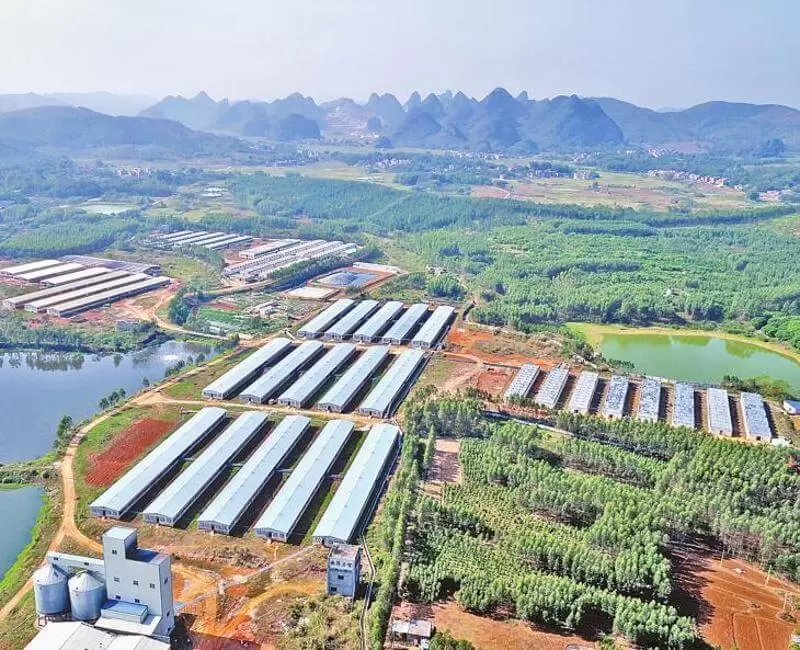
Site Selection and Layout Planning for Pig Farms
A scientifically and reasonably planned pig farm layout is essential for normal pig production and achieving high efficiency. Farm construction should be guided by whether it meets pigs’ biological needs, facilitates indoor air control, enables efficient production organization, supports strict biosecurity and sanitation measures, and produces good economic and social outcomes.
Site Selection Choosing the right site is key to successful pig farming. Proper site selection and thoughtful architectural planning and layout not only facilitate production but also provide a solid foundation for implementing biosecurity measures. In practice, consider pigs’ biological characteristics, production method and scale, and evaluate terrain, soil texture, surrounding environment, water source and quality, power supply, waste disposal and environmental protection, land area, and traffic access.
- Terrain and Topography The farm site should be open and regular in shape—not overly long or narrow, with few angled corners—and have sufficient area. Prefer sites that are slightly elevated, dry, flat, wind-sheltered and sun-exposed, with gentle slope and good drainage (1%–3% slope). Slopes should not exceed 20% to avoid transportation difficulties inside the farm. On sloping land, choose wind-sheltered, sun-exposed locations to aid cold protection and improve farm environment. Low-lying sites are prone to waterlogging and humidity, poor summer ventilation, stagnant hot air, and higher mosquito and microbial risk; they are cold and damp in winter, so avoid wetlands and low-lying irrigated land. To avoid flood risk during rainy seasons, select a site above the historical maximum flood level.
- Soil Texture Soil physical, chemical, and biological properties affect pig health and productivity. Ideal farm soil is well-draining and aerated, has low water retention and hygroscopicity, weak capillary action, low thermal conductivity, and good insulation; it should resist contamination by organic matter and pathogens, be free of endemic soil-borne diseases, have a low groundwater table, and not be marshy. Uncontaminated sandy loam or loam soils are preferable for farm construction.
- Surrounding Environment Pig farms generate large volumes of feed, products, manure, and waste, so sites must have convenient transport, reliable electricity, nearby feed supply and product sales, and capability for on-site manure and waste handling to reduce costs and prevent environmental pollution. For biosecurity and to minimize impact on neighbors, choose sites distant from villages, residential areas, slaughterhouses, livestock markets, and major roads, and preferably downwind of residential areas and drinking-water sources. Recommended minimum distances: 300–500 m from national first- and second-grade highways; >200 m from third-grade roads; 50–100 m from fourth-grade roads. Generally, farms should be >500 m from residential areas (large farms >1,000 m); >500 m from ordinary livestock farms (large livestock farms 1,000–1,500 m). Within 1,000 m, avoid locating near polluting industries such as chemical plants, slaughterhouses, livestock markets, tanneries, paper mills, or mines.
- Water Source and Quality Pig farms require large water volumes—for drinking, flushing pens and animals, cleaning and feed preparation, staff use, firefighting, and irrigation. Water sources are typically groundwater or surface water. Whatever the source, supply must be adequate, water quality good, easily protected, and easy to access.
- Waste Disposal and Environmental Protection Sites should be located away from towns and residential areas and situated downwind or to the side of prevailing wind directions to avoid odor, wastewater, and manure processing affecting residents. Farm elevation should be lower than residential areas to prevent runoff from contaminating homes. Surrounding farmland or orchards are useful for local reuse of manure and wastewater. If on-site reuse is not feasible, wastewater treatment and environmental protection must be a key part of planning, especially measures to prevent contamination of groundwater, surface water, and rivers.
- Land Area Required farm area depends on the farm’s purpose, nature, scale, and site characteristics. Insufficient area leads to crowded buildings, poor farm and barn environment, and difficulties in management and disease control. For breeding farms, the total building area can generally be estimated at 20–25 m² per sow; areas for auxiliary production and living/management facilities should be planned according to actual scale.
Recent Comments