
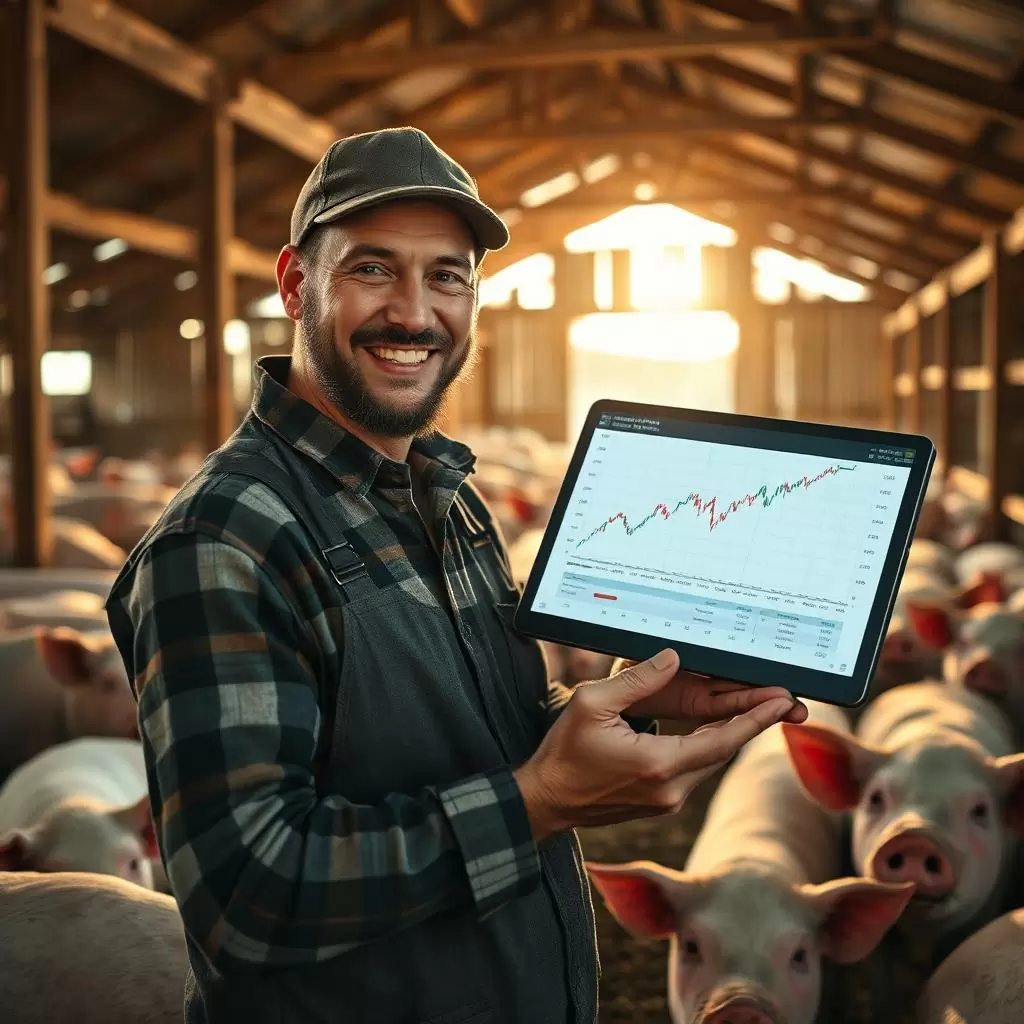
How Pig Farmers Can Cope with Pork Market Volatility
Market volatility closely affects pig-farming returns. Understanding volatility patterns requires market forecasting; only on that basis can farmers seize opportunities to start or expand pig stalls and farms.
Seize the opportunity to start or expand
When others are slaughtering sows, building a pig stall or buying sows to expand production can be advantageous: breeding stock is easier to obtain and prices are lower. If timed well, expansion during such troughs often allows farmers to catch the next upturn and earn substantial profits.
Understand the relationship between market swings and farming returns
Market swings affect profitability in both directions — large profits or large losses are possible, and many farmers underestimate the magnitude of this difference. When the industry is profitable, many begin sow-rearing or expand scale, increasing demand for breeding stock; some animals unfit for breeding are still used as breeders. Because sow reproductive capacity affects supply with a lag, oversupply typically takes 2–4 years (or longer) to emerge. Conversely, when returns drop, some farmers leave the business or rapidly cull sows, so the decline in market supply often happens faster than the rise. This asymmetry makes losses and gains differ greatly in scale. Sow production is a long-term business; persistence is critical to eventual success — overall gains tend to outweigh losses for those who stay the course.
Master market-forecasting methods
Correct forecasting reduces operational risk. Main forecasting approaches for the pork market include: major-factor analysis, cyclical/regularity analysis, and quantitative (mathematical) models.
Major-factor analysis: Monitor key drivers that influence market volatility — consumer demand, natural disasters, and grain harvests (especially corn and soy). Changes in these factors provide predictive value.
Regularity (cycle) analysis: Pork price fluctuations are closely linked to herd inventory, which typically follows 2–4 year cycles. Use historical cyclical patterns to inform decisions and measures.
Mathematical-model methods: Use historical survey and vetted literature data to perform qualitative and quantitative analyses, identify development patterns, and build mathematical models. Input current data into these models to produce forecasts, then analyze forecast errors and determine their causes to refine the model.
Practical takeaway: combine timely market observation with cycle awareness and quantitative tools so pig stall and farm operators can better time expansions, manage herd size, and reduce the financial risks of market volatility.
Recent Comments