
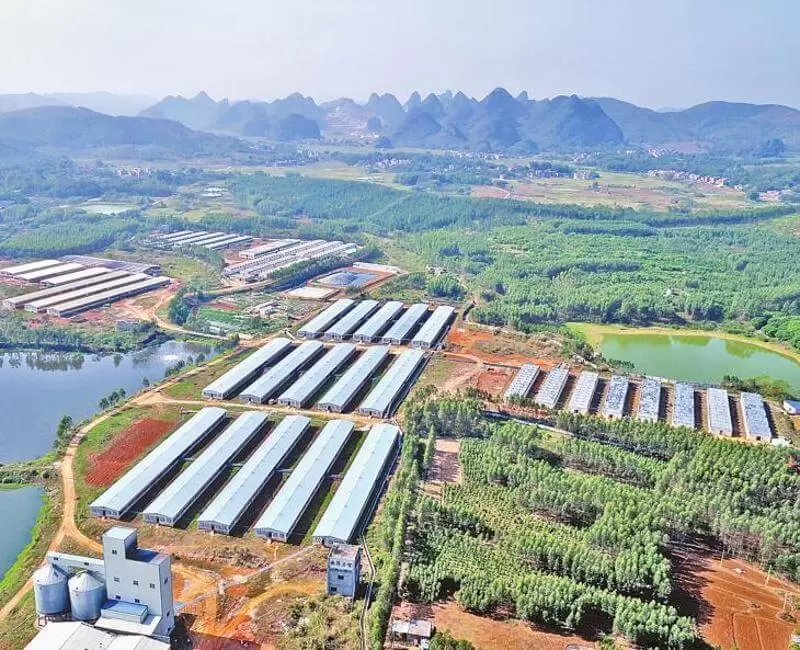
Building Layout for Pig Farms
Proper building layout arranges each structure’s position, orientation, and spacing, and optimizes placement of piggery equipment. When planning, consider functional relationships between buildings, biosecurity, ventilation, daylighting, fire safety, and land efficiency.
Location
The living and production-management zones connect closely with the outside and should be near the main gate for biosecurity. Provide separate disinfection pits for pedestrians and vehicles at the entrance, with a guard/post and changing room at the sides. Positions of production-area barns should follow site topography and prevailing winds, and be arranged for easy pig flow and disease control. Locate major piggery equipment—feed mills, water towers, and loading platforms—so they are accessible but do not compromise biosecurity. From higher to lower ground and aligned with the dominant annual wind, arrange barns in this order: boar house, empty/gestation sow house, farrowing house, nursery, finishing barns, testing pens, and loading/unloading platform. Veterinary clinic, isolation barns, manure storage and disposal facilities—which carry contamination risk—should be placed at the lowest, downwind part of the site, at least 50 m from the production area.
Orientation
Barn orientation affects ventilation, daylight, and waste discharge; choose based on local prevailing wind and sun exposure. In summer, barns should minimize solar radiation and allow strong, even ventilation; in winter, they should receive more sunlight and limit cold drafts. In hot regions, orient barns to maximize natural ventilation and reduce solar heating; in cold regions, orient to minimize cold wind penetration and increase solar gain. Avoid aligning a barn’s long axis strictly parallel or perpendicular to the prevailing wind. Position piggery equipment (fans, pad cooling, and feed lines) to support airflow patterns and efficient service access. A generally recommended orientation is south-facing or within 45° east/west of south.
Barn Spacing
Appropriate spacing improves summer ventilation, winter sunlight, and disease control. Layout should be neat and practical to facilitate roads, water/drainage, landscaping, and electrical lines, and to simplify production and management. Distances must meet light, ventilation, biosecurity, fire-safety, and land-use needs. A typical spacing between two barn rows is 10–20 m. Place large piggery equipment—feed silos, treatment systems, and slurry handling units—on service roads to avoid cross-contamination. Loading/unloading platforms should be placed outside the perimeter wall to prevent contamination and disease risk from external vehicles.
Summary
Farm layout should follow local topography, terrain, and wind conditions while meeting veterinary and fire-safety rules. Arrange buildings and piggery equipment compactly according to their functional relationships to minimize transport and utility lines, support mechanization, and reduce construction, management, and operating costs.
Recent Comments