
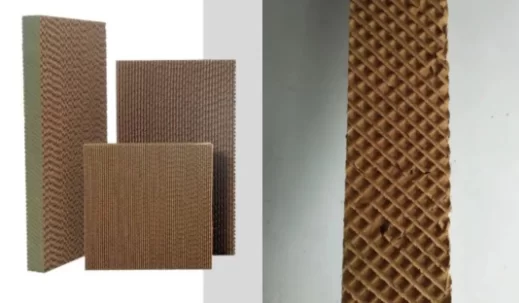
How to Use Evaporative Cooling Pad Correctly in Summer
Pad cooling (evaporative cooling pad) is the primary cooling method in livestock houses during summer. Many farmers want to know how to use pads correctly to keep house temperatures within a reasonable range. Below are key points to consider when using pad cooling in summer.
Understanding Cooling Pads
Cooling pads are made of a special paper material and have a honeycomb structure.
Pad thicknesses are 5 cm, 10 cm, and 15 cm. In hot, humid regions, 15 cm pads are usually preferred.
A 15 cm pad is typically designed for air velocity through the pad of 1.78–2.29 m/s; a 10 cm pad is designed for 1.27–1.52 m/s.
The pad angle should be chosen according to local climate. In hot, low-humidity environments, a 45/15 ventilation duct angle is more effective.
How Pad Cooling Works
Enthalpy-balanced cooling and humidification: as air passes through the pad, water evaporates and absorbs sensible heat, lowering air temperature; water vapor enters the air, increasing latent heat and humidity. Sensible and latent heat exchange balance so enthalpy remains nearly constant. Cooler air increases wind-chill effect on birds, reducing perceived temperature and relieving heat stress. Humidity must be controlled to avoid reduced heat dissipation efficiency.
For every 1°C the house temperature drops from pad cooling, indoor humidity typically rises by about 4.5%.
Pads are not used solely to cool; their main role is to keep house temperature within a reasonable range.
The fundamental function of pads is to enhance the wind-chill (wind-cooling) effect.
Calculating Pad Area
How do you calculate required pad area? Pads are the main equipment for cooling in high temperatures and must work with fans, so pad area must be sufficient. Pad area = total ventilation volume ÷ air velocity through the pad. Convert ventilation to cubic meters per second. For 15 cm pads, use an airspeed of about 1.5–2 m/s; for 10 cm pads, use 1–1.5 m/s. Practical formula: required pad area = (maximum house ventilation) / 3600 / 1.7 m/s. In practice, 15 cm pads typically use 1.7 m/s as the through-pad speed. Example: a house 100 m long, 12 m wide, eave height 3.8 m, ridge height 1.5 m has a volume of 5,640 m³. Pad area = 5,640 m³ ÷ 60 s ÷ 1.7 m/s = 55.3 m². In summer, the house air should be exchanged at least once per minute. In practice, 1–2 backup fans are usually added, so actual exchange time is under one minute and ventilation exceeds 5,640 m³, meaning pad area should be sized slightly larger.
Key Points and Precautions for Pad Use
The goal is not to drop 35°C air to 21°C. Pads are used to keep temperature within a reasonable range; after startup, temperature typically fluctuates within about 1°C.
Before turning on pads, use longitudinal ventilation first to lower temperature by increasing wind speed.
Principle: after pads are turned on, house temperature should fall but not trigger the last group of fans to stop running.
Avoid direct cold drafts on birds after pads are activated. Use angled pad boards to guide airflow where available; if not, use plastic sheeting to direct the airflow.
Monitor external humidity and control pad wetting. When outside humidity exceeds 80% (a “sauna” condition), pad cooling is ineffective; run more fans to rely on wind-chill cooling.
After pads are activated, check that inlet side small windows are tightly closed to prevent local heat-stress hotspots. Maintain temperature difference between front and rear of the house within 2°C—ensure the number of fans matches the inlet openings.
Recent Comments